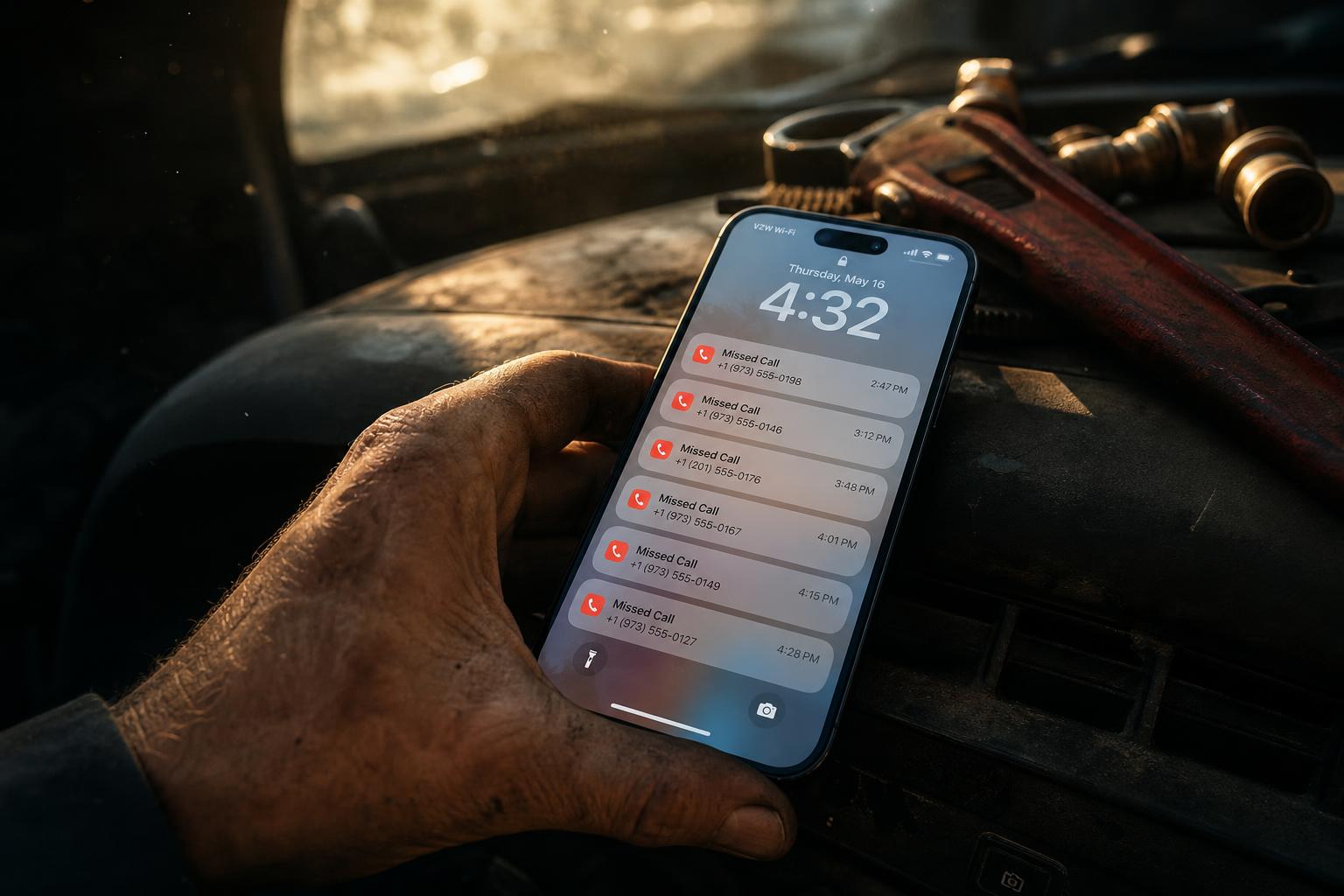
Your Follow-Up Process Is 'Absolutely Terrible.' You're Not Alone.
Every contractor we talk to knows they should follow up more. Most don't. Not because they're lazy, but because follow-up built on memory and good intentions collapses the moment the day gets busy. Which is every day.

The short answer: Every contractor we talk to knows they should follow up more. Most of them don't. Not because they're lazy, but because follow-up built on memory and good intentions collapses the moment the day gets busy. Which is every day. Here's what's actually happening, why it costs you more than you think, and the only system that works when humans can't.
You Already Know This Is a Problem
Ask a contractor how their follow-up process is working and you'll hear the same answer, almost verbatim:
"Honestly? It's terrible."
Not "it could be better." Not "we're working on it." Terrible. That's a direct quote from a real contractor, one running a real business, with real revenue, and real leads falling through cracks every single week.
The thing is, they know it. You probably know it too. The leads you called once and never heard back from. The estimates you sent and never followed up on. The customers who used you last year and haven't heard from you since.
You meant to call them. You just never did.
This isn't a character flaw. It's a systems problem. And the distinction matters, because willpower won't fix a systems problem. A system will.
Why "I'll Follow Up Tomorrow" Is a Lie You Tell Yourself
Here's what a typical contractor's follow-up "system" looks like:
- Lead comes in
- Tech visits or estimate is sent
- Office notes it in their CRM (maybe)
- Someone means to follow up
- Something urgent happens
- Follow-up doesn't happen
- Repeat
The average home services business handles 30-80 new leads per month. Add in open estimates, past customers due for seasonal service, and unbooked callbacks, and you're looking at hundreds of touchpoints that need active follow-up at any given time.
No human being reliably manages that from memory. Not even close.
The #1 reason follow-up fails: it depends on someone remembering. And in a business where phones are ringing, jobs are running, and someone's always putting out a fire, the thing that gets forgotten is almost always the thing that doesn't have a deadline attached to it.
Follow-up doesn't have a deadline. So it gets pushed. And then it dies.
The Real Cost of "We'll Call Them Back"
Here's what "I'll follow up tomorrow" actually costs:
Lost leads. A lead that doesn't get a second contact within 24-48 hours has an 80%+ chance of going cold. The close rate on second-touch attempts drops by more than half if the delay is over 48 hours. See the full breakdown in our slow lead response analysis.
Lost estimates. Most home services businesses close 40-60% of estimates on first contact. The remaining 40-60% didn't say no. They went quiet. Mitchell Roofing put it plainly: "I close 40-60% in person, but I'm losing 20-30% in follow-up." That gap doesn't close by accident.
Lost recurring revenue. A customer you serviced 12 months ago is more likely to book again if you reach out first. If you don't, they Google someone when they need service. That's not loyalty, that's convenience. And you're not convenient if you're silent.
At a $2,000 average ticket, losing 5 follow-ups per month is $120,000 per year. That's not hypothetical. That's math.
Why This Is Worse Than You Think: The Invisible Loss
The frustrating part about follow-up failure is that you don't see the damage.
A botched service call shows up as a complaint. A missed delivery shows up as a refund. But a lead who never heard back from you? They just hired your competitor. No complaint. No callback. No signal. Just silence, and a job you never knew you lost.
Gray Electric & Plumbing was following up $200,000 in open estimates by hand. Wingman Heating had $700,000 in open estimates being tracked manually. These are real businesses. Real revenue. Real risk of it quietly evaporating every time the office gets busy.
The jobs you don't close from follow-up failure don't show up on a report. They just don't show up at all.
The 4 Follow-Up Failure Modes (Which One Is Yours?)
Failure Mode 1: The Single-Touch Operation
You call once or send one estimate. If they don't respond, they fall off the list. The most common failure mode, and it leaves 20-40% of recoverable revenue on the table.
Failure Mode 2: The Sticky Note System
Follow-ups are tracked via sticky notes, whiteboards, or personal memory. Works great with 5 leads. Completely collapses with 50.
Failure Mode 3: The CRM Graveyard
Leads are logged in ServiceTitan, Jobber, or HCP, but nobody goes back to work them. The CRM becomes a record-keeping system instead of a follow-up system. Data in, no action out.
Failure Mode 4: The Heroic CSR
One person in the office heroically manages follow-up through sheer will. She's doing 3 jobs at once, inevitably misses things, and when she's out sick for two days, nothing gets followed up. Ever.
All four of these fail for the same reason: they require a human to initiate action. That's a variable that breaks under load.
What the Fix Actually Looks Like
The contractors who solve follow-up don't solve it by hiring more people or working harder. They solve it by removing the human dependency from the initiation step.
Here's the system that works:
Step 1: Trigger is automatic, not manual.
When a lead comes in → sequence starts. When an estimate is sent and not accepted within 3 days → follow-up fires. When a customer hasn't been back in 12 months → loyalty campaign activates. No one has to remember. The trigger is event-based.
Step 2: First touch goes out in minutes, not days.
The window to make contact is short. Automated SMS within 60 seconds of a lead submission outperforms a manual call placed 6 hours later, consistently.
Step 3: Multi-touch sequence runs without intervention.
Day 1. Day 3. Day 7. The sequence doesn't forget. It doesn't get busy. It doesn't take a Tuesday off. Every lead, every estimate, every lapsed customer, touched on schedule.
Step 4: Human involvement starts when there's a conversation.
When someone replies, your team picks it up. That's the handoff point. Not the initiation. Humans close deals. Automation makes sure the conversation happens.
Step 5: Everything syncs to your CRM.
ServiceTitan, Jobber, HCP, all updated automatically. Your team wakes up with a prioritized inbox of active conversations, not a list of 200 people to call cold.
What Contractors Say When the System Is Running
Once contractors have automated follow-up in place, the conversations shift.
Instead of: "I know we should follow up, but..."
They say: "I didn't realize how much was slipping through."
Instead of: "My CSR does her best, but she can't get to everyone."
They say: "My CSR is only dealing with people who are already warm."
Instead of: "Our follow-up is honestly terrible."
They say: "We recovered $157,000 from open estimates last month."
That last one is Hometown Heating. One campaign. Existing pipeline. Zero new ad spend.
The Follow-Up Math: What Recovering 15% of Missed Touches Is Worth
| Scenario | Missed Follow-Ups/Month | Avg. Ticket | Annual Recovery at 15% |
|---|---|---|---|
| Conservative | 10 | $1,200 | $21,600 |
| Mid-market | 20 | $2,500 | $90,000 |
| High-volume | 40 | $4,000 | $288,000 |
These numbers assume 15% recovery. Trades with warm pipelines and no prior follow-up system often see 20-30% in the first 90 days.
One recovered job per month pays for the platform. You're not recovering one. You're recovering dozens.
Frequently Asked Questions
Why do contractors struggle with follow-up even when they know it's important?
Because follow-up requires initiation, and initiation requires remembering. In a high-volume service business, the urgent always beats the important. Follow-up is important but never urgent, so it loses every time to the thing in front of you.
How many follow-up attempts should I make before giving up?
Three minimum. Most contractors stop at one or zero. 80% of sales require 5+ contacts, but 44% of salespeople give up after one follow-up. In home services, the sequence should be: first touch within 24 hours, second at 3-5 days, third at 30 days. After three attempts with no response, flag the lead for personal outreach or file it.
Can I fix my follow-up process without automation?
Yes, if your volume is low enough. Under 15 leads per month, a disciplined human process can work. Above that, you're playing the odds. At 40+ leads per month, it's not a question of if the system breaks down. It's when.
What's the best follow-up channel for home services?
SMS by a wide margin. 95-98% open rate. Read within 3 minutes on average. Phone calls go to voicemail, emails go to spam or sit unread. A text reaches them where they are, immediately.
Does automated follow-up feel impersonal to customers?
Not when it's done right. Personalization (name, job type, specific context) makes automated messages feel personal. Customers regularly describe automated texts as feeling like a real person reached out. The alternative, not following up at all, feels like you didn't care.
What happens when someone replies to an automated message?
The conversation is flagged and routed to your team in real time. Automation handles initiation. Humans close. That's the division of labor that works.
How does CHIIRP handle follow-up sequences?
CHIIRP connects to your ServiceTitan, Jobber, or Housecall Pro account, pulls active leads and open estimates, and triggers timed SMS sequences automatically. You set the rules once, CHIIRP runs them every time, without exceptions.
The Bottom Line
You're not alone in having a terrible follow-up process. Almost every contractor we talk to describes the same thing, good intentions, a busy team, and a pile of leads and estimates that quietly expired because nobody got back to them.
The fix isn't hiring another CSR or working harder. It's removing the human dependency from the initiation step, so follow-up happens every time, on schedule, regardless of how busy the day gets.
CHIIRP, the SMS revenue platform for home services, automates the follow-up process end-to-end, from new lead to open estimate to lapsed customer. Your team closes. The system makes sure the conversation happens.
Book a demo with CHIIRP and we'll show you exactly how many leads and estimates are sitting in your pipeline right now with no follow-up scheduled.